

History of the Department
 The Department was first established in September in the 1975/76 academic year. Since its creation the department has changed name several times, and finally in May 2021 it was named Department of Toxicology. The first appointed teacher in the course Toxicological Chemistry was then associate professor Branko Nikolin, who is one of the founders of the Faculty of Pharmacy in Sarajevo. As part of equipping the Department, the necessary laboratory equipment and instruments were acquired, including a UV-VIS spectrophotometer, a spectrofluorimeter, an infrared spectrophotometer, two gas chromatographs, and ion selective electrodes. During the 1984 Winter Olympic Games in Sarajevo, the Olympic Laboratory for Doping Control was established within the Department, headed by Prof. dr. Nikolin Branko. The Department was then fully equipped with state-of-the-art equipment, among other things, with the HPLC and GC-MS system which, at the time, in 1983, was the first of its kind in Bosnia and Herzegovina. The laboratory established in January 1984 was accredited as the twelfth of the kind in the world. As part of the preparation process for the accreditation, the Department's staff collaborated with the Institute of Pharmacology of the University of Los Angeles School of Medicine (UCLA). The result of this collaboration was the introduction of an analytical method for determining the presence of exogenous testosterone in urine using a coupled gas chromatography-mass spectrometry system, instead of the previously used radioimmunochemical method. The HPLC method for the quantitative analysis of caffeine and its derivatives was also introduced, which also became the official method after the XIV Winter Olympic Games. The laboratory was reaccredited for doping control at international competitions organized by the International Amateur Athletics Federation (IAAF) in 1987. At the beginning of the war, in June 1992, the RHB (radiological-chemical-biological) laboratory was established at the Department, and worked until 1996. The work in the Laboratory was performed by a team of experts from diferent areas essential for protection against radiological, biological and chemical hazards. During that period, hundreds of samples of food, drinking water and medicines were analyzed. As part of the Tempus project Study of Pharmacy Reestablished on European level in the Bosnia and Herzegovina Universities in 1999, the Department was equipped with IT equipment and a significant number of books, textbooks, manuals and other literature.
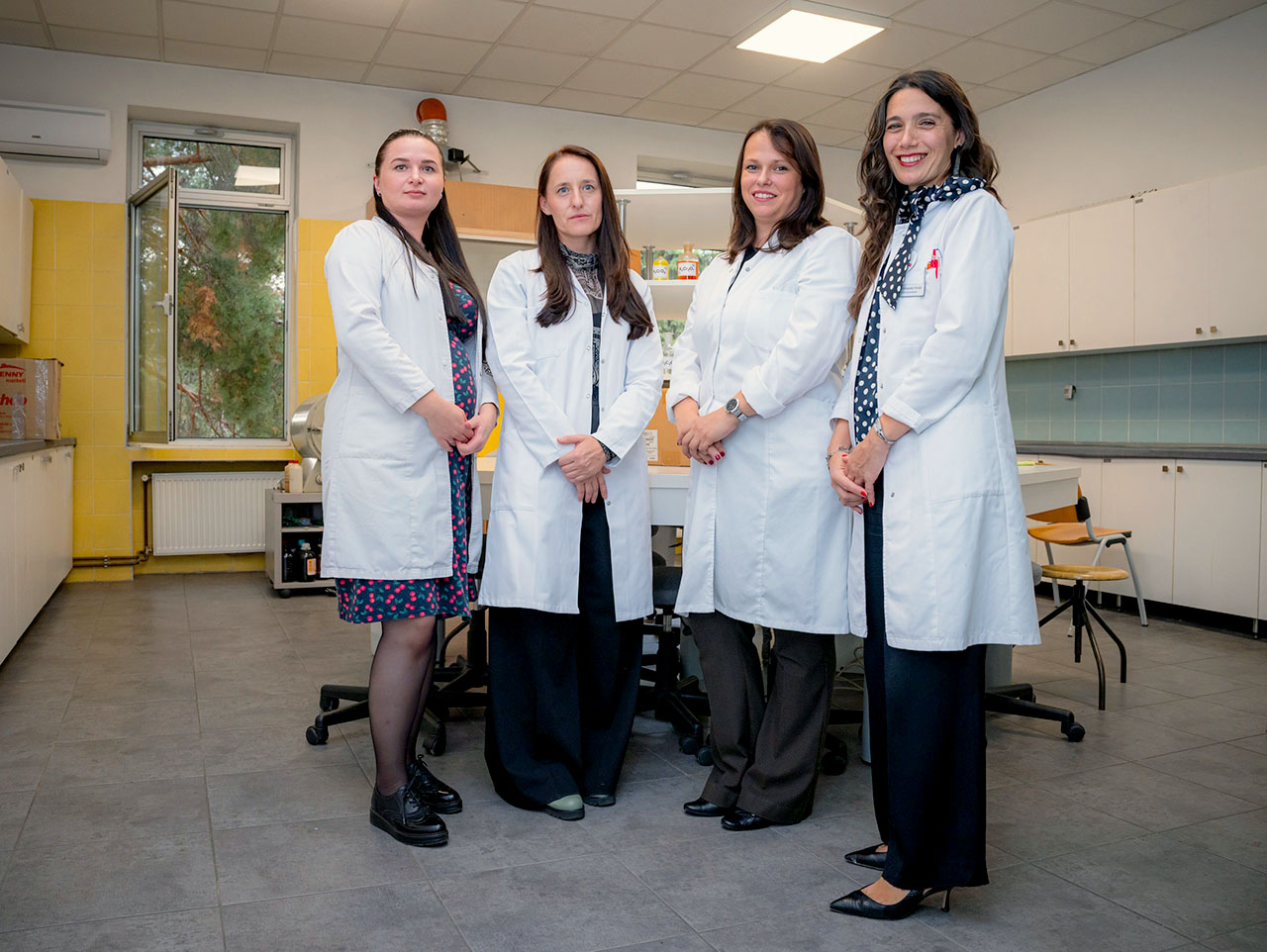
Teaching and professional staff currently involved in the teaching process
- Full Professor Aleksandra Porobić, from 2003
- Associate Professor Elma Omeragić, from 2007
- Senior Teaching and Research Assistant Aida Lugušić, Mpharm., spec., from 2019
- Sanela Drinjak, Pharmaceutical technician, from 2016
 |
 |
 |
 |
|
Aleksandra Porobić |
Elma Omeragić |
Aida Lugušić |
Sanela Drinjak
|
Teaching activities
Teaching activites at the Department are carried out through delivering specific pharmaceutical ecourses, which essentially, to a lesser or greater extent, include the application of the principles and methods of chemical analysis in solving specific problems of monitoring the presence of foreign substances in the environment, food and biological material. Since its establishment up to now, the course in toxicological chemistry was developed for the undergraduate study, and upon the introduction of curricula according to the Bologna system of study, the Department developed the following elective courses as well. Selected topics in toxicological chemistry: Food toxicology and food safety, Selected topics in toxicological chemistry: Abuse of drugs in sport and Selected topics in Toxicological chemistry: Toxicological risk assessment. The teaching staff of the Department is involved in teaching at the post-graduate or doctoral study program „Pharmaceutical research“, through the courses Endocrine disrupting chemicals in food and environment and Toxicological risk assessment. A significant part of the specialization program in the field of toxicological chemistry, i.e. Analytical and Forensic Toxicology, intended for the pharmacists and carried out according to the program of the Ministry of Health of the FBiH, is implemented at this Department. The Department of Toxicology is also a partner of the CEEPUS network Training and research in environmental chemistry and toxicology, through which the international mobility of students and teaching staff from the Department is implemented. Teachers of the Department have participated in teaching at other universities in BiH and abroad (Croatia), and as invited speakers they held several lectures at the Brno University of Technology (Czech Republic) and the Faculty of Health Studies, University of Ljubljana (Slovenia).
Since its establishment to the present day, four doctoral dissertations, eight master's theses, 71 bachelor's theses, 105 final theses of the integrated study program of the first and second cycle, and five specialist theses have been produced at the Department.
Academic and professional activities
Research areas of the Deapartment include analytical and forensic toxicology, food and environmental toxicology, investigation of persistent organic pollutants and heavy metals in the environment and biological (human) samples, abuse of drugs in sport and toxicological risk assessment.
Historically, since the establishment of the Department, the research areas have included: investigation of the insecticidal potential of nicotine alkaloids and their new crystalline salts with organic acids and metals; examination of Ergot and Clavine alkaloids; investigation of the androgen hormones metabolism with a special focus on detection of exogenous testosterone in urine and its influence on other hormones and their metabolism; monitoring of polycyclic aromatic hydrocarbons in the air at industrial areas especially monitoring concentrations of substances with carcinogenic, teratogenic and mutagenic effects.
The Department inherits a long tradition of research activities and completion of numerous scientific projects. To date, the Department has carried out 18 research projects funded by domestic and foreign bodies. Particularly significant is the cooperation with the Norwegian Institute for Water Research (NIVA) from Oslo, which was a partner in three international projects focused on monitoring the presence of persistent organic pollutants (POPs) in rivers in BiH, as well as on the implementation of the Stockholm Convention on POPs.